Prayagraj | India’s defence preparedness must be driven by relentless research and the ability to achieve strategic surprise in an era defined by rapid technological disruption, said Rajnath Singh while addressing the inaugural session of the North Tech Symposium in Prayagraj.
The three-day event, organised by the Indian Army’s Northern and Central Commands in collaboration with the Society of Indian Defence Manufacturers, brought together defence personnel, industry leaders, start-ups, and academic experts to deliberate on emerging technologies shaping modern warfare.
“Adaptation Will Decide Future Wars”
Highlighting the fast-changing nature of conflict, the Defence Minister said that the nation which adapts most swiftly to technological revolutions will gain a decisive edge in future wars. He pointed to recent global conflicts, including the Russia-Ukraine war, where battlefield dynamics have shifted rapidly from traditional armoured warfare to drone- and sensor-driven operations.
He also referred to unconventional threats emerging in modern warfare, stressing that even everyday technologies are being repurposed for military use, making preparedness more complex and urgent than ever before.
Focus on Surprise and Strategic Capability
Rajnath Singh emphasised that the element of surprise has historically defined the outcome of wars, and India must continuously strengthen its capability to respond decisively when required. He noted that the armed forces are already moving in this direction but stressed the need for further acceleration through innovation and proactive planning.
Defence Research at Core of Policy
Calling defence research central to national security priorities, the Minister said the government is actively strengthening the ecosystem through the Defence Research and Development Organisation (DRDO), which is increasingly working in partnership with industry, academia, and start-ups.
He highlighted that more than 2,200 technologies have already been transferred to industry partners, while over ₹4,500 crore has been utilised by private players under various defence research initiatives. Additionally, 25% of the defence R&D budget has been allocated to industry and academic participation.
A revised technology transfer policy has also eliminated earlier fees for development and production partners, significantly easing collaboration between DRDO and private stakeholders.
Push for Next-Gen Warfare Technologies
The Defence Minister urged industry and innovators to focus on cutting-edge domains such as directed energy weapons, hypersonic systems, underwater domain awareness, space situational awareness, quantum technologies, artificial intelligence, and machine learning.


He assured full government support in accelerating innovation in these strategic areas.
Operation Sindoor Showcased Indigenous Strength
Referring to recent military developments, Rajnath Singh described “Operation Sindoor” as a clear demonstration of India’s evolving technological warfare capabilities. He said the operation highlighted the effective use of indigenous systems, including advanced missile platforms like Akash and BrahMos, reinforcing India’s growing defence confidence.
Record Growth in Defence Production and Exports
The Minister also highlighted India’s growing self-reliance in defence manufacturing. Domestic defence production has reached a record ₹1.54 lakh crore in FY 2025–26, while exports have surged to an all-time high of ₹38,424 crore.
He said this growth reflects increasing private sector participation and rising global interest in Indian defence capabilities.
Towards a Unified Innovation Ecosystem
Describing the symposium theme—“Where Technology, Industry & Soldiering Converge”—as highly relevant, the Minister called for the creation of a knowledge-sharing corridor to strengthen collaboration across stakeholders.
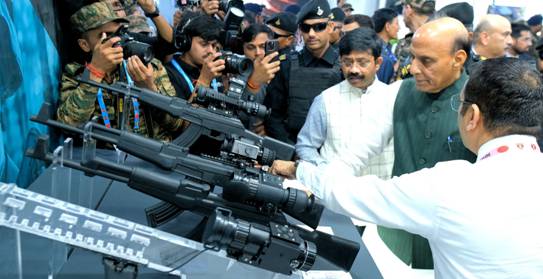
Senior military leadership, including top commanders of the Army, Air Force, and defence research institutions, along with industry representatives and academics, participated in the event. Around 284 companies showcased indigenous defence technologies at the accompanying exhibition.
The symposium is expected to generate actionable strategies aimed at bridging operational gaps and enhancing India’s long-term defence readiness in a rapidly evolving global security landscape.













 https://www.youtube.com/watch?si=RtToJsBhYBatUrym&v=mOuYNSdhjHA&feature=youtu.be